
Access to clean water is a critical global challenge. Millions of people in coastal regions, islands, and remote areas lack reliable freshwater. However, a mobile sea water RO plant offers a powerful and proven solution. Furthermore, these systems work for emergency relief, military operations, and industrial use. Therefore, mobile seawater desalination is transforming how the world accesses clean water.
In this guide, you will learn how a mobile sea water RO plant works. Additionally, you will discover where teams use them and why they represent the future of portable water treatment.
What is a Mobile Sea Water RO Plant
A mobile sea water RO plant is a portable seawater desalination system that converts seawater into high-quality freshwater using reverse osmosis (RO) technology. Moreover, it is fully self-contained and ready to operate on arrival.
Unlike fixed desalination facilities, these systems need no heavy construction. Furthermore, operators can deploy a mobile sea water RO plant anywhere — at remote beaches, disaster zones, offshore oil rigs, and military bases.
Engineers mount these systems on trailers, skids, or shipping containers. As a result, teams can transport them easily by road, sea, or air. Additionally, a complete unit includes pre-treatment filters, high-pressure pumps, RO membranes, post-treatment systems, and control panels.
Capacity Range of Mobile RO Plants
Capacity varies widely across different models. Smaller systems produce as little as 5 cubic meters per day. On the other hand, larger industrial mobile SWRO plants generate over 1,000 cubic meters per day. Therefore, these systems serve both small communities and large industrial operations.
How Mobile Seawater Desalination Works
Reverse osmosis forms the core technology of mobile seawater desalination. It forces saline water through semi-permeable membranes under high pressure. As a result, water molecules pass through while salts, heavy metals, bacteria, and viruses stay blocked.
In a mobile sea water RO plant, the process follows several clear stages. Furthermore, each stage plays a critical role in water quality and system performance.
Stage 1: Intake and Pre-Treatment
- Seawater Intake: Operators draw raw seawater using intake pumps. Screens remove large debris before the water enters the system.
- Pre-Treatment Filtration: The water passes through multi-media and cartridge filters. Therefore, fine particles and turbidity are removed before the RO stage.
- Chemical Dosing: Automated systems inject anti-scalant and biocide at precise doses. This protects the membranes and extends their service life.
Stage 2: High-Pressure RO Filtration
- High-Pressure Pumping: Powerful pumps pressurize the water to 55–70 bar. This pressure overcomes the natural osmotic pressure of seawater.
- RO Membrane Filtration: The water moves through polyamide RO membranes. Consequently, more than 99% of dissolved salts are rejected.
- Energy Recovery: Advanced systems include energy recovery devices (ERDs). As a result, energy consumption drops significantly.
Stage 3: Post-Treatment and Distribution
- Post-Treatment: The water undergoes UV disinfection, chlorination, and remineralization. Thus, it meets international drinking water standards.
- Storage and Distribution: Finally, operators store clean water in tanks and distribute it for use.
This entire process runs automatically within the compact framework of a mobile sea water RO plant.
Key Components of a Mobile Sea Water RO Plant
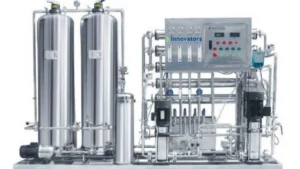
A high-performance portable seawater desalination system relies on several key components. Moreover, each part plays an essential role in reliability, efficiency, and water quality.
Mechanical Components
- Intake and Feed Pumps: These draw seawater from the source and push it into pre-treatment.
- Multi-Media Pre-Filters: Sand and anthracite filters remove suspended solids and organic matter.
- Cartridge Filters: These protect RO membranes from microscopic particles.
- High-Pressure Pumps: Industrial pumps generate the pressure the RO membranes need to operate.
- RO Membrane Vessels: The core of the seawater purification system. They reject dissolved salts at high efficiency.
- Energy Recovery Devices: Pressure exchangers cut overall power consumption by up to 60%.
Automation and Control Components
- Chemical Dosing Systems: Automated systems inject anti-scalant and biocide at precise doses.
- Control Panel and SCADA System: PLC panels with HMI screens monitor and control all system parameters in real time.
- Containerized or Trailer Frame: A ruggedized structure that houses all components. It forms the basis of a complete containerized RO plant and enables rapid deployment.
- Post-Treatment Systems: UV sterilizers and remineralization filters ensure final water meets drinking standards.
Together, these components form a fully self-contained industrial seawater RO plant. As a result, it produces safe drinking water wherever operators deploy it.
Benefits of Mobile Seawater Desalination Systems
The adoption of mobile seawater desalination has grown rapidly worldwide. This is because it delivers a wide range of important benefits for industries and governments.
Operational Benefits
- Rapid Deployment: Teams can commission a mobile sea water RO plant within 24 to 72 hours. Therefore, it suits emergency response and military deployment perfectly.
- No Civil Construction Required: Unlike permanent plants, mobile systems need no foundation work. As a result, setup costs drop significantly.
- Operational Flexibility: Teams can relocate or upgrade units as water demand changes. Furthermore, this makes them a sound long-term investment.
- Scalability: Operators can pair systems to increase capacity. On the other hand, individual units serve smaller applications independently.
Economic and Environmental Benefits
- Cost Efficiency: Eliminating civil works reduces total ownership costs. Consequently, mobile plants are often more economical for temporary applications.
- Proven Technology: Reverse osmosis is a globally proven technology. Moreover, mobile plants use the same membranes as large municipal desalination plants.
- Low Environmental Footprint: Teams build no permanent infrastructure. Therefore, the impact on coastal ecosystems stays significantly lower.
- Water Quality Compliance: Mobile sea water RO plants consistently produce water that meets WHO Drinking Water Quality Guidelines. Thus, they suit direct human consumption.
Where Mobile Seawater Desalination Plants Are Used
The versatility of mobile seawater desalination means teams use these systems across many settings. Furthermore, their portability suits both permanent and temporary applications.
Emergency and Remote Applications
- Remote Coastal Communities: Island villages and coastal settlements rely on mobile desalination as their primary water supply.
- Disaster and Emergency Response: After hurricanes or earthquakes, mobile sea water RO plants provide immediate relief. Moreover, teams can airlift or truck them in quickly.
- Military and Defense Bases: Armed forces deploy mobile SWRO plants to maintain water independence. This gives them a critical strategic advantage.
Industrial and Commercial Applications
- Offshore Oil and Gas Platforms: Workers need large freshwater volumes daily. Therefore, teams mount container desalination systems directly on platform decks.
- Construction and Mining Projects: Remote coastal projects use mobile plants for worker water supply. As a result, they avoid dependence on scarce local freshwater resources.
- Tourism and Hospitality: Remote resorts use portable seawater desalination to deliver high-quality water. Consequently, guests experience no impact from local water shortages.
- Temporary Events and Festivals: Major coastal events deploy mobile desalination units. Thus, organizers guarantee water supply without local infrastructure dependence.
Industries That Use Mobile Desalination
Mobile seawater desalination has entered many industries. Furthermore, each sector uses portable RO technology to solve specific water supply challenges.
Key Industries Served by Mobile SWRO Plants
- Oil and Gas: Offshore companies rank among the largest users of containerized seawater RO plants. They maintain self-sufficiency for crews and operations.
- Marine and Shipping: Cruise ships and large vessels deploy offshore desalination plants. As a result, they produce drinking water directly from the sea.
- Government and Municipal Authorities: Local governments use mobile sea water RO plants to supplement supply during droughts or infrastructure failures.
- Humanitarian Aid and NGOs: Relief organizations deploy mobile SWRO units in conflict zones and disaster areas. Therefore, clean water reaches people in need quickly.
- Military and Defense: Defense departments invest in mobile desalination for logistics independence. Consequently, operations do not rely on local water sources.
- Agriculture and Aquaculture: Coastal farms use portable seawater desalination for irrigation. Furthermore, aquaculture facilities use it for process water.
- Industrial Manufacturing: Coastal plants in food processing, pharmaceuticals, and textiles use industrial seawater RO applications. Thus, they supplement or replace scarce freshwater sources.
Future of Mobile Seawater RO Technology
The future of mobile sea water RO plants looks very promising. Furthermore, rapid technological advances drive the next generation of mobile seawater desalination systems.
Technology Trends Driving the Future
- Solar and Renewable Energy Integration: Mobile RO systems now combine with solar PV arrays and battery storage. As a result, fully off-grid desalination is becoming a reality.
- Advanced Membrane Technology: Next-generation membranes offer higher permeability and greater salt rejection. Therefore, energy consumption continues to fall.
- Smart Monitoring and Remote Control: AI-powered systems enable real-time remote monitoring. Consequently, operators run plants with minimal on-site labor.
- Improved Energy Recovery: Next-generation pressure exchangers push energy consumption to new lows. Thus, mobile desalination becomes viable in even the most remote locations.
- Modular Containerized Designs: Standardized modular designs cut manufacturing costs. Furthermore, they enable faster global deployment.
Climate Change and the Growing Global Demand
As droughts and saltwater intrusion intensify, mobile seawater desalination becomes essential. Therefore, it plays a central role in climate adaptation strategies worldwide. Moreover, investment in mobile sea water RO plants today builds long-term water security for future generations.
Frequently Asked Questions
What is a mobile sea water RO plant?
A mobile sea water RO plant is a portable desalination system. It converts seawater into safe drinking water using reverse osmosis membranes and high-pressure pumps. Furthermore, manufacturers mount it on a trailer, skid, or shipping container for rapid deployment anywhere in the world.
What is mobile seawater desalination?
Mobile seawater desalination removes salt and contaminants from seawater. It uses portable reverse osmosis systems to produce clean, potable water. Moreover, it needs no fixed infrastructure, making it ideal for remote or temporary deployments.
Where do operators use mobile desalination plants?
Operators use them in coastal communities, remote islands, and offshore platforms. Additionally, they serve military bases, disaster relief operations, construction sites, and remote resorts where freshwater is scarce or unavailable.
How much water can a mobile RO plant produce?
A mobile sea water RO plant produces between 5 and 1,000 cubic meters of freshwater per day. Smaller units serve humanitarian needs. On the other hand, larger containerized systems serve industrial and municipal applications.
Is desalinated seawater safe to drink?
Yes, it is completely safe to drink. The water goes through UV disinfection, remineralization, and chlorination. As a result, it meets WHO and international drinking water standards before distribution.
How long does installation of a mobile seawater desalination plant take?
Teams make a mobile sea water RO plant fully operational within 24 to 72 hours of arrival. Furthermore, the system needs no civil construction. Therefore, commissioning is fast and cost-effective compared to permanent plants.
What is the energy consumption of a mobile sea water RO plant?
Modern plants with energy recovery devices consume 3 to 5 kWh per cubic meter. Additionally, systems with solar power integration further reduce dependence on diesel fuel. Consequently, operating costs drop significantly.
A mobile sea water RO plant combines the proven science of reverse osmosis with the flexibility of mobile engineering. Furthermore, it delivers a dependable and scalable water solution for communities, industries, and emergency situations worldwide. As water scarcity grows globally, investment in mobile SWRO technology is not just a commercial decision. Moreover, it is a commitment to water security for generations to come.