
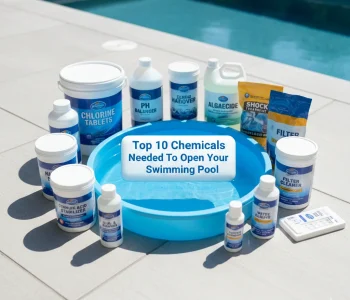
1. Shock (Chlorine or Non-Chlorine)
What it is: Shock is a high-dose, fast-acting oxidizer designed to “shock” your pool system. It’s the workhorse that will obliterate organic contaminants, kill algae spores, and burn off chloramines (the combined chlorine that causes red eyes and that strong “chlorine” smell).
Why it’s Essential for Opening: Your pool has been sitting stagnant for months. It’s full of dead leaves, pollen, and potentially live algae. Regular chlorine levels can’t handle this level of contamination. Shock provides the nuclear option to sanitize the water quickly.
When to Add: This is often your first major chemical addition after physically cleaning the pool (removing debris, vacuuming, and brushing). It’s best to shock the pool in the evening or at night, as sunlight degrades chlorine.
Types:
Calcium Hypochlorite (Cal-Hypo): Powerful, inexpensive, and common. It adds calcium to the water, so be cautious if you have hard fill water.
Sodium Dichlor: A stabilized chlorine shock that also contains Cyanuric Acid (CYA). Good if your stabilizer is low, but can lead to over-stabilization if used repeatedly.
Non-Chlorine Shock (Potassium Peroxymonosulfate): An oxidizer that doesn’t kill algae but is excellent at clearing hazy water and destroying chloramines. You can swim just 15 minutes after adding it.
2. Algaecide
What it is: A chemical specifically formulated to prevent and kill algae. It works by breaking down the algae’s cell walls.
Why it’s Essential for Opening: Even if you can’t see algae yet, its microscopic spores are likely present. A preventative dose of algaecide during opening provides a protective barrier, stopping a bloom before it can start. If your pool is already green, you’ll need a stronger, curative algaecide alongside a heavy shock treatment.
When to Add: After you’ve shocked the pool and the chlorine levels have dropped back to normal (below 5 ppm). Adding it while chlorine is super-high can render the algaecide ineffective.
Types:
Polymer Algaecide (60%): Great for prevention and mild algae issues. It is non-foaming and gentle on equipment.
Copper-Based Algaecide: Very effective but can stain pool surfaces if not used correctly or if the pH is unbalanced.
Quaternary Ammonia (Quat): An economical option, but can cause foaming.
3. Chlorine Stabilizer (Cyanuric Acid – CYA)
What it is: Cyanuric Acid is a “sunscreen” for your chlorine. It protects free chlorine from being rapidly destroyed by the sun’s UV rays.
Why it’s Essential for Opening: Without stabilizer, up to 90% of your chlorine can be lost within just a few hours of sunlight. If you’re opening a pool that was properly closed, the CYA level might still be adequate (30-50 ppm is ideal). SIn areas with high mineral content or brackish source water, proper filtration before filling the pool can reduce chemical demand and improve long-term water balance.
However, if you’ve drained and refilled, or if the CYA reading is low, you must add it. A pool open chemical kit often includes a small amount.
When to Add: Early in the process, as it can take 24-48 hours to fully dissolve. The best method is to place it in a sock and hang it in front of a return jet or place it in the skimmer basket.
Warning: More is NOT better. Over-stabilization (CYA > 80 ppm) locks up your chlorine, making it ineffective, a problem known as “chlorine lock.” You’ll be shocked and shocked, but the algae won’t die. The only fix is to partially drain and refill the pool.
4. Sanitizer (Chlorine Tabs or an Alternative)
What it is: This is your pool’s primary, long-term defense system. It maintains a constant residual level of sanitizer (1-3 ppm Free Chlorine) to kill bacteria and pathogens continuously.
Why it’s Essential for Opening: While shock handles the initial contamination, you need a steady hand to keep the water safe for swimming day in and day out.
When to Add: After the initial shock has done its job and chlorine levels have subsided, you need to establish a consistent sanitizer routine. Add tabs to a floating dispenser or an in-line chlorinator.
Types:
Trichlor Tablets: The most common. They are slow-dissolving, highly concentrated, and also add stabilizer (CYA) to the water.
Liquid Chlorine (Sodium Hypochlorite): Very effective, doesn’t add CYA or calcium, but its strength degrades quickly over time, especially if stored improperly.
Salt Chlorine Generator: Not a chemical per se, but a system that generates its own chlorine from salt. If you have a saltwater pool, opening involves checking the salt levels and starting up the generator.
5. pH Balancer (pH Increaser & Decreaser)
What it is: These are chemicals used to adjust the pH level of your water, which is a measure of its acidity or basicity. The ideal range is 7.4 to 7.6.
pH Increaser: Typically Sodium Carbonate (Soda Ash).
pH Decreaser: Typically Sodium Bisulfate or Muriatic Acid.
Why it’s Essential for Opening: pH is the cornerstone of water balance. If your pH is too high (>7.8), your chlorine becomes sluggish and inefficient, your water can turn cloudy, and scale can form on your pool walls and equipment. If it’s too low (<7.2), the water becomes corrosive, damaging metal components like ladders and heaters, and it can irritate swimmers’ eyes and skin. This is why a pool open chemical kit with pH balancer is so valuable—it ensures you have the tools to correct this critical parameter.
When to Add: After the water has been circulated for 24 hours and you have your initial test results. Always adjust pH before adjusting Total Alkalinity, as TA acts as a buffer for pH.
6. Total Alkalinity (TA) Increaser
What it is: Sodium Bicarbonate—yes, the same stuff as baking soda, just in a pool-grade formulation.
Why it’s Essential for Opening: Total Alkalinity is the measure of your water’s ability to resist pH change. It acts as a buffer. If TA is too low, your pH will be unstable and “bounce” all over the place (a condition called “pH bounce”). If TA is too high, it makes the pH resistant to change and will tend to drive the pH up, leading to scaling.
When to Add: After you’ve addressed the pH, but before you fine-tune other chemicals. The ideal range for TA is 80-120 ppm. Correcting TA first often helps to stabilize your pH in the process.
7. Calcium Hardness Increaser
What it is: Calcium Chloride.
Why it’s Essential for Opening: This measures the amount of dissolved calcium in the water. If it’s too low (<150-200 ppm for vinyl, 200-250 for fiberglass, and 250-350 for plaster/gunite), the water becomes “aggressive” and will try to leach calcium from your pool’s plaster walls, causing etching and deterioration. If it’s too high (>400 ppm), the water becomes “scaling” and can deposit calcium carbonate on your surfaces, equipment, and inside your heater, forming unsightly white crust.
When to Add: Once pH and TA are balanced. This is a crucial step for protecting the longevity of your pool’s finish.
8. Clarifier or Flocculant (Floc)
What it is: Chemicals that clump together tiny, suspended particles that your filter can’t catch on its own.
Clarifier: Works slowly, clumping particles into masses large enough for the filter to remove. It’s a gentle aid.
Flocculant (Floc): The heavy artillery. It causes particles to clump together and sink to the bottom of the pool, where you must manually vacuum them to waste.
Why it’s Essential for Opening: After shocking, you often have a pool full of dead algae and other microscopic debris that makes the water hazy or milky. Your filter can’t clear it alone.
When to Add: Use a clarifier if the water is just hazy after several days of filtering. Use floc as a last resort if the water is extremely cloudy and nothing else is working. Remember: When vacuuming after using floc, you MUST vacuum to “Waste,” not through the filter, or you will clog it instantly.
9. Metal Sequestrant
What it is: A chemical that binds to metals like iron, copper, and manganese in the water, keeping them in solution and preventing them from staining your pool surface or turning the water strange colors.
In commercial facilities where water quality is critical, advanced industrial water purification systems help remove dissolved minerals, salts, and contaminants before they affect water quality.
Why it’s Essential for Opening: If you are filling your pool with well water or if you have copper pipes that have corroded over the winter, your water may contain metals. When you adjust the pH or add shock, these metals can oxidize, causing brown (iron) or green (copper) stains. A sequestrant acts like an insurance policy against this.
When to Add: It’s a great preventative measure to add during the opening process, especially if you suspect metals are present.
10. Stain & Scale Preventative
What it is: A multi-purpose chemical, often a blend of sequestrants and scale inhibitors, designed to protect your pool from both metal stains and calcium scale.
Why it’s Essential for Opening: This is the ultimate “ounce of prevention.” It’s easier and cheaper to prevent a stain than to remove one. By adding this at opening, you create a protective layer for the entire season.
When to Add: After the water is balanced and clear. It’s a great final step to ensure a trouble-free summer.
Your Step-by-Step Pool Opening Chemical Plan
Now that you know the players, let’s put them in the right order.
Physical Clean-Up: Remove the cover, clean and store it. Scoop out leaves and debris. Vacuum the pool floor and brush the walls and floor thoroughly.
Fill & Circulate: Top off the water to the middle of the skimmer. Start the pump and filter system, and run it continuously for 24 hours.
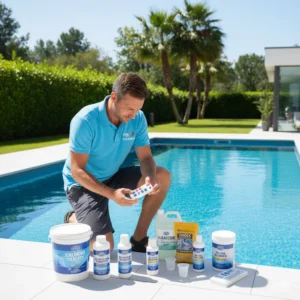
Test the Water: Get your baseline readings for pH, TA, CH, FC, and CYA.
Adjust the Fundamentals: Balance your pH and Total Alkalinity first. This creates a stable foundation.
Shock the Pool: Bring the “nuclear option” to bear. Add a heavy dose of shock at dusk. Keep the pump running.
Add Preventatives: The next day, add your initial dose of algaecide and metal sequestrant.
Check Stabilizer & Hardness: Test and adjust CYA and Calcium Hardness as needed.
Establish Sanitation: Once chlorine levels from the shock have dropped below 5 ppm, add your chlorine tablets to a dispenser to maintain a residual.
Final Touches: If the water is still hazy after a few days, add a clarifier. Add a stain and scale preventative for long-term protection.
Final Test & Swim: Once your water is crystal clear and your chemical levels are all in the ideal range (FC: 1-3 ppm, pH: 7.4-7.6, TA: 80-120 ppm, CH: 200-350 ppm, CYA: 30-50 ppm), it’s time to take that first, refreshing swim!
The Convenience of a Kit
If this list feels overwhelming, remember the convenience of a pre-packaged pool opening kit. A good pool open chemical kit will contain pre-measured amounts of shock, algaecide, and often a clarifier or stain preventer. An even better pool open chemical kit with pH balancer will include pH increaser and decreaser, covering almost all your initial needs. They are a fantastic, cost-effective way to ensure you have the core swimming pool opening chemicals without buying large, separate containers.
Your Partner for a Pristine Pool: Innovators Dubai
While this guide empowers you to tackle pool opening yourself, we understand that your time is valuable. Between work, family, and enjoying the Dubai lifestyle, complex pool maintenance can be a hassle. What if you could guarantee a perfect pool opening without spending your weekend balancing chemicals?
That’s where we come in.
At Innovators Dubai, we are the leading experts in swimming pool maintenance and care. Our team of certified professionals lives and breathes water chemistry and pool systems. We don’t just follow steps; we understand the science, ensuring your pool is not only crystal clear but also perfectly balanced for the unique demands of the Dubai climate.
Why Choose Innovators Dubai for Your Pool Opening Service?
Expertise & Precision: We go beyond a standard pool opening kit. Our technicians perform comprehensive digital water testing and provide a tailored chemical treatment plan for your specific pool.
Time-Saving Convenience: Let us handle the messy work. We’ll physically clean your pool, manage the entire chemical process, and ensure your equipment is running perfectly, giving you back your weekend.
Guaranteed Results: No more guessing games. We guarantee a sparkling, swim-ready pool that provides a safe and inviting oasis for you and your family.
Preventative Care: Our service includes a full equipment check to identify potential issues with pumps, filters, and heaters before they become costly repairs.
The Right Chemicals, Precisely Dosed: We use only the highest quality pool chemical products, applied in the correct order and quantity, eliminating the risk of chemical waste or imbalance.
Frequently Asked Questions (FAQs) About Pool Opening Chemicals
Q1: I bought a standard pool opening kit. Is that all I need?
A standard pool opening kit is an excellent starting point as it contains the core chemicals like shock and algaecide. However, it may not cover all scenarios. Your pool’s specific needs depend on your initial water test results. You will likely need additional chemicals to adjust pH, Alkalinity, and Calcium Hardness, which is why a pool open chemical kit with pH balancer is a better choice, or better yet, our professional service which includes all necessary chemicals tailored to your water.
Q2: What is the single most important thing to do when opening my pool?
Test your water! You cannot properly balance your pool if you don’t know the starting levels of pH, Alkalinity, and Sanitizer. All chemical additions are based on these test results.
Q3: How long after adding chemicals can I swim?
This is a critical safety question. The wait time varies by chemical:
After Shocking (with Chlorine): Wait until the Free Chlorine level drops back to safe levels (1-3 ppm). This can take 8-24 hours. Always confirm with a test kit.
After Algaecide, Clarifier, or Balancers: It is generally safe to swim after about 15-20 minutes of circulation, provided the chlorine and pH levels are within the normal range. Always check the product label for specific instructions.
Q4: My pool is still green after shocking it. What did I do wrong?
A green pool that persists after shocking is often a sign of one of two issues:
The pH was unbalanced when you shocked, making the chlorine ineffective.
The chlorine is “locked up” due to very high Cyanuric Acid (Stabilizer) levels. The only solution for this is to partially drain and refill the pool to dilute the CYA.
Q5: Can you provide a basic swimming pool chemicals list for a beginner?
Absolutely. For a simple start, ensure you have:
Shock (Chlorine-based)
Chlorine Tablets (for ongoing sanitation)
pH Increaser & Decreaser
Total Alkalinity Increaser
Algaecide (for prevention)
This covers the fundamentals, but a complete swimming pool chemicals list for optimal care would also include Calcium Hardness Increaser, Cyanuric Acid (Stabilizer), and a Metal Sequestrant.
Q6: Why is the water in my new pool cloudy after opening?
Cloudy water is typically caused by fine particles that your filter can’t remove. This often happens after shocking as it kills algae and other organics. The solution is to ensure your filter is running 24/7 and to use a pool clarifier to clump the particles together so the filter can remove them. If it’s extremely cloudy, a flocculant (floc) may be needed.
Q7: Why should I hire Innovators Dubai instead of doing it myself?
Our service provides peace of mind, saves you significant time and effort, and guarantees a professional result. We identify and solve problems you might miss, ultimately saving you money on wasted chemicals and potential equipment repairs down the line. We turn a complex chore into a simple, hassle-free experience.
Conclusion: A Sparkling Summer Awaits
Opening your pool with the right chemicals isn’t just about making it look good—it’s about ensuring a safe, healthy, and enjoyable environment for your family and friends all season long. By understanding the role of these top 10 chemicals and following a logical sequence, you can demystify the process. Ditch the green monster and welcome a summer of pristine, inviting, and perfectly balanced water. Your perfect pool day is just a few chemical additions away.