
A pipeline bursts at a remote coastal construction camp. A Category 4 cyclone knocks out the municipal water supply for an entire island district. A military unit advances into a coastal zone with no logistical water chain behind it. A humanitarian team lands at a disaster site where every well has been contaminated by floodwater.
That is precisely what emergency use seawater desalination exists to answer. Not tomorrow. Not after a week of civil preparation. Today — within hours of deployment. This article explains exactly how emergency seawater desalination works, who needs it, what makes a rapid-response system genuinely effective, and how Innovators Dubai has built a deployment capability that serves that urgent need across the UAE, GCC, and beyond.
What Is Emergency Use Seawater Desalination?
Emergency use seawater desalination is the rapid deployment of mobile reverse osmosis technology to convert raw ocean water into safe, potable fresh water — in situations where conventional water supply has failed, been destroyed, or was never available in the first place.
The word “emergency” here carries real operational weight. It does not describe a system that takes two weeks to commission or requires a concrete foundation and a licensed civil contractor before it produces a single drop. A genuine emergency desalination system arrives at site ready to run. It connects to seawater. It produces clean water. It does this within hours — not days.
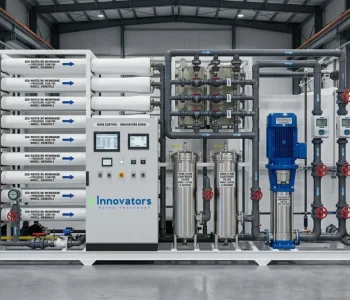
The underlying technology is the same seawater reverse osmosis process used in large fixed desalination plants worldwide. High-pressure pumps force raw seawater through semi-permeable polyamide membranes. The membranes reject dissolved salts, bacteria, viruses, and contaminants. Clean fresh water passes through. Concentrated brine is discharged back to sea. What makes emergency systems different is not the science — it is the engineering around that science. Speed of deployment. Self-contained design. Operational independence from local infrastructure. These are the factors that separate a genuine emergency system from a standard industrial unit.
Who Actually Needs Emergency Seawater Desalination?
The range of clients who reach out to Innovators Dubai for emergency desalination capability is wider than most people expect. Fresh water emergencies do not happen only in war zones or after natural disasters. They happen on construction sites, offshore platforms, remote resorts, and island communities — wherever the margin between water availability and water need is thin.
Disaster Response Organisations and Government Bodies
Coastal flooding, cyclones, tsunamis, and earthquakes frequently destroy or contaminate the groundwater and piped water supply that communities depend on. For government civil defence agencies, national disaster management authorities, and international humanitarian organisations operating in the UAE and GCC region, the ability to deploy a self-contained seawater desalination unit within hours of a disaster event is not a planning consideration — it is a life-safety requirement.
The Arabian Gulf and the wider Indian Ocean region have experienced exactly these events. When they occur, every hour without safe drinking water increases the risk of dehydration, waterborne disease, and public health collapse. Emergency desalination units are not a luxury in these scenarios. They are frontline infrastructure.
Military and Defence Operations
Modern military operations in coastal environments cannot rely on extended logistical water supply chains. Forward operating bases, naval shore parties, and rapid deployment forces operating along coastlines need water independence from the moment they establish a position. A trailer-mounted or containerized emergency seawater RO plant gives military operators exactly that — the ability to draw water from the sea and produce drinking, cooking, and hygiene water without depending on any local civilian infrastructure.
Innovators Dubai has supplied systems to defence-related clients in the region who require rapid deployment capability, ruggedised construction, and operational simplicity — systems that field personnel can operate without specialist water treatment expertise.
Offshore Oil Platforms and Marine Facilities
An offshore platform or drillship that loses its primary water treatment system is not in a position to pause operations while replacement equipment is ordered from overseas. Workers need water every day. Production cannot stop. Emergency desalination capability — either as a backup system or as a rapid-deployment rental unit — is a genuine operational necessity for oil and gas operators working in coastal and offshore environments across the Gulf.
Remote Coastal Construction Sites
Infrastructure development in the UAE and GCC frequently takes place in locations where municipal water simply does not reach. When a construction camp’s water supply arrangement fails — whether a trucking contract collapses, a borehole runs dry, or a storage system is damaged — hundreds of workers are immediately without safe water. Emergency seawater desalination provides the bridge between supply failure and a permanent solution. Our portable RO systems are specifically designed for exactly this kind of rapid deployment.
Island Communities and Remote Coastal Resorts
Island communities throughout the wider Gulf and Indian Ocean region rely on either limited groundwater reserves or imported water. When either of those supply lines fails — through drought, contamination, or logistical disruption — the community faces an immediate fresh water crisis. Remote luxury resorts and eco-lodges face a parallel version of the same problem. Guest experience and operational continuity both depend on uninterrupted fresh water supply. Emergency desalination capability is increasingly part of the resilience planning for operators in these environments.
The Five Non-Negotiable Requirements of a True Emergency System
Not every portable desalination system qualifies as a genuine emergency deployment solution. The word “emergency” implies specific performance requirements that standard portable systems often cannot meet. Here are the five criteria that Innovators Dubai uses to evaluate whether a system is genuinely fit for emergency deployment.
1. Deployment Speed — Water Within Hours, Not Days
A genuine emergency system must be capable of producing water within 24 hours of arriving at a new coastal location. For smaller units — up to 20 to 30 cubic meters per day — the target is closer to 4 to 8 hours from arrival to first water production. Systems that require civil preparation, extended electrical commissioning, or specialist assembly before they can run do not meet this standard. Every hour of commissioning delay in a genuine emergency represents real harm to real people.
Innovators Dubai engineers every emergency deployment system around this constraint. Units arrive pre-commissioned from the factory. All internal connections are made and tested before shipping. On site, the crew makes four external connections — seawater intake, brine discharge, power, and product water outlet — and the system starts. Nothing more is required.
2. Complete Operational Independence
Emergency deployments happen precisely where infrastructure is absent, damaged, or destroyed. A system that requires a stable grid power supply, a local chemical supplier, or specialist operator expertise to function is not suitable for genuine emergency use. True emergency desalination capability means the system carries everything it needs — pre-treatment, RO membranes, post-treatment, chemical dosing systems, control panels, and if required, its own generator — within a single deployable unit.
This is why containerized and trailer-mounted configurations are the preferred formats for emergency deployment. The container or trailer is the system. Everything required for water production travels inside it. When the unit arrives, it is already a functioning water plant. Local infrastructure provides only the seawater feed and the power connection — and even the power requirement can be eliminated with an integrated generator package.
3. Ruggedised Construction for Harsh Conditions
Emergency deployments happen in difficult environments. Storm-affected coastal zones. Desert construction sites in 45°C summer heat. Remote island locations with salt-laden humid air. Offshore platforms exposed to constant spray and vibration. Equipment that performs reliably in a controlled factory environment may fail rapidly under these conditions. Emergency seawater desalination systems must be built to withstand the environment they are deployed into — with marine-grade stainless steel, corrosion-resistant coatings, sealed electrical enclosures, and components rated for the full range of ambient temperatures encountered in the Gulf region.
4. Simple Operation — Minimal Training Required
In a genuine emergency, the people operating the desalination system may not be trained water treatment engineers. They may be disaster response workers, military personnel, construction site supervisors, or community volunteers. Emergency systems must be operable by competent non-specialists — with clear controls, automatic safety shutdowns, and straightforward maintenance procedures. UV sterilizers and automated dosing systems reduce operator intervention requirements and ensure water quality is maintained even when experienced operators are not available on site.
5. Rapid Redeployment Capability
Emergency situations evolve. A system deployed at one location may need to move to a different site within days or weeks as the situation develops. True emergency desalination capability means the system can be demobilized and redeployed at a new location without significant rebuild, reconfiguration, or logistical complexity. Trailer-mounted units that run on their trailer without being lifted off provide the fastest redeployment cycle. Containerized units offer the broadest logistical flexibility — moving by truck, ship, or helicopter sling load depending on access conditions.
Emergency Deployment Configurations — What Innovators Dubai Supplies
Innovators Dubai maintains a range of emergency-capable seawater desalination configurations. Each serves a specific deployment scenario. Choosing the right configuration upfront determines how quickly water flows at site — and how much operational flexibility the client retains over the course of the emergency.
Trailer-Mounted Emergency Seawater RO Units
The trailer-mounted configuration is the fastest to deploy along any road-accessible coastline. The entire system — pre-treatment filtration, high-pressure RO skid, post-treatment dosing, and control panel — sits on a purpose-built, road-legal trailer with its own axles and tow coupling. A standard 4×4 or flatbed truck moves it to site. The system operates directly from the trailer. It does not need to be lifted off, levelled, or anchored. Deployment time from arrival to first water production is as low as 4 to 6 hours for units in the 5 to 50 cubic meter per day range.
This configuration is the preferred choice for civil defence agencies, humanitarian organisations, and military operators who need to respond rapidly to an evolving coastal emergency and may need to reposition the system multiple times during the response operation.
Containerized Emergency Seawater Desalination Plants
The containerized RO plant configuration offers the broadest logistical reach. A standard 20-foot ISO container fits on any flatbed truck, loads into any container ship, and can be airlifted by heavy lift helicopter when road access is not available. All equipment is pre-installed, pre-commissioned, and protected within the steel container shell. On site, the container doors open, four connections are made, and water production begins. Containerized units are available in output ranges from 10 cubic meters per day up to several hundred cubic meters per day — covering everything from a village water supply to a large construction camp or forward operating base.
The container shell itself provides significant protection against harsh coastal environments — shielding the equipment from direct sun, salt spray, dust, and rain. For deployments expected to run for weeks or months rather than days, the containerized format offers the best combination of logistics flexibility and equipment protection.
Skid-Mounted Rapid Deployment Units
Where helicopter deployment or vessel delivery is required and container dimensions create access constraints, skid-mounted emergency units offer a compact alternative. All components sit on a low-profile structural steel frame that can be moved by forklift, crane, or deck crane on a supply vessel. Skid-mounted units are particularly well suited to offshore and marine emergency applications where deck space is limited and overhead clearance restricts container deployment.
Water Quality in Emergency Conditions — What the System Must Achieve
Emergency desalination is not simply about producing water quickly. It must produce water that is safe. In an emergency, the stakes of water quality failure are higher — not lower — than in normal operating conditions. People are already stressed, potentially dehydrated, and in some cases already exposed to contamination. Providing water that causes illness is worse than no water at all.
A properly specified emergency seawater desalination system consistently produces drinking water that meets WHO and UAE drinking water standards. This requires a complete treatment train — not just RO membranes alone. Pre-treatment through multimedia filtration removes suspended solids and turbidity that would otherwise damage membranes or compromise output quality. Anti-scalant dosing prevents mineral fouling. The RO membranes themselves remove dissolved salts, heavy metals, bacteria, and viruses to levels well below drinking water limits. Post-treatment UV sterilization and chlorine dosing provide final disinfection and residual protection in the storage and distribution system.
Every Innovators Dubai emergency deployment system includes this complete treatment train as standard. We do not supply RO-only systems for emergency drinking water applications. The pre-treatment and post-treatment stages are not optional extras — they are what ensures the water leaving the system is genuinely safe to drink under the variable and often challenging feed water conditions encountered in real emergency deployments.
Feed Water Challenges in Emergency Seawater Desalination
One of the most underestimated challenges in emergency seawater desalination is feed water variability. In a standard installation, the feed water quality is assessed before system design, and the pre-treatment is engineered to match. In an emergency deployment, the system often arrives at a location where feed water conditions are unknown, variable, or significantly worse than normal.
Coastal emergency zones frequently have elevated turbidity from storm surge and flooding. Algal bloom events — common in the Arabian Gulf during certain seasons — can dramatically increase biological load in the seawater feed. Shallow coastal intakes in disaster zones may draw in debris, sediment, and contamination that would not affect a properly designed fixed intake. Emergency systems must be engineered to handle these worst-case feed water conditions without sacrificing output quality or causing rapid membrane fouling.
Innovators Dubai specifies emergency units with enhanced pre-treatment capacity — larger multimedia filter vessels, higher-capacity cartridge pre-filtration, and chemical dosing systems sized for elevated biological and turbidity loads. This over-specification is deliberate. In emergency conditions, we would always rather have more pre-treatment capacity than the minimum required under ideal conditions.
Rental vs Purchase — Which Makes Sense for Emergency Preparedness?
This is one of the most common questions Innovators Dubai receives from organisations planning their emergency water supply strategy. The answer depends on the nature of the organisation and the type of emergency they are preparing for.
When Rental Is the Right Choice
For most organisations — construction companies, resort operators, offshore contractors, and project developers — emergency desalination rental is the operationally and financially sensible choice. The emergency, by definition, is not a regular occurrence. Owning and maintaining a dedicated emergency desalination system that sits idle between emergencies creates ongoing costs for equipment that generates no value during normal operations.
Innovators Dubai’s emergency rental programme provides fully maintained, deployment-ready seawater desalination units available on short notice across the UAE and GCC. The rental unit arrives at site already commissioned and tested. Our team handles delivery, connection assistance, and ongoing technical support for the duration of the deployment. When the emergency is resolved, we demobilize and recover the unit. The client pays only for the period of use — with no capital investment, no maintenance responsibility, and no storage requirement.
When Purchase Is the Right Choice
For government civil defence agencies, large humanitarian organisations, military operators, and remote island communities where water supply emergencies are a recurring risk, owning a dedicated emergency desalination capability makes strategic sense. Ownership provides immediate availability — no waiting for a rental unit to be located, transported, and delivered. The unit is on standby, ready to deploy at the first sign of a water supply crisis.
Innovators Dubai supports owned emergency units with structured preventive maintenance programmes that keep systems deployment-ready at all times. A unit that has been sitting in storage for eighteen months without maintenance is not a reliable emergency asset. Our maintenance contracts ensure that when the emergency arrives, the system starts first time and performs to specification.
How Innovators Dubai Responds to an Emergency Desalination Request
When an organisation contacts Innovators Dubai with an emergency water supply need, the response process is direct and fast. This is not a situation for lengthy tender processes or multi-week procurement cycles.
First contact triggers an immediate technical assessment. Our engineers ask the essential questions: location, seawater access, daily volume requirement, power availability, and timeline. Within hours of first contact, we confirm the right system specification, availability from our UAE-based inventory, and a realistic deployment timeline. For rental deployments, units can typically be mobilized within 24 to 72 hours for UAE locations — and within a week for regional GCC deployments depending on logistics.
Our field engineering team handles delivery, positioning, connection, commissioning, and initial water quality testing on site. We train the client’s designated operators on day-to-day system management. We establish a 24/7 technical support contact for the duration of the deployment. And we maintain remote monitoring capability on equipped units — allowing our engineers to track system performance and identify issues before they become breakdowns.
📞 If you are facing a water supply emergency right now — contact Innovators Dubai immediately:
🌐 innovators-dubai.com/contact-us | ✉️ Info@innovators-dubai.com | 📱 +971-544942902 | Dubai, UAE
Emergency Preparedness — Planning Before the Crisis Arrives
The worst time to identify your emergency water supply solution is after the emergency has already started. By then, logistics are complicated, options are limited, and decisions are made under pressure with incomplete information. The organisations that respond most effectively to water supply emergencies are those that identified and pre-qualified their emergency desalination provider before they needed one.
Innovators Dubai works with clients across the UAE and GCC on emergency preparedness planning — assessing their specific water supply risk profile, identifying the right emergency desalination specification for their scenario, and establishing a pre-qualified rental or standby supply arrangement that can be activated immediately when needed. This planning costs nothing to put in place. The value it delivers in the event of an actual emergency is enormous.
If your organisation operates in a coastal location — whether an offshore platform, a remote construction project, an island resort, or a government facility — and you do not have a confirmed emergency water supply plan, the right time to address that gap is today.
The Innovators Dubai Difference — Two Decades of Water Solutions Across the UAE
Innovators Dubai has been engineering and deploying water treatment solutions across the UAE, GCC, and international markets for over twenty years. Our capability spans the full range of water treatment needs — from large industrial RO plants and brackish water treatment systems through to compact marine water makers and ultrafiltration systems for commercial applications.
In the emergency desalination space specifically, that experience means we understand what actually happens during a real deployment — not just what should happen in theory. We have seen feed water conditions that no standard specification anticipated. We have commissioned systems in 45°C heat on exposed desert coastlines. We have supported clients who needed technical guidance at 2am because their night-shift operator had a question. That real-world operational experience is built into how we specify, build, and support every emergency system we supply.
We also maintain a UAE-based inventory of genuine spare parts — RO membranes, high-pressure pump components, cartridge filter elements, UV lamp assemblies, and dosing pump parts — so that when something needs replacing in the field, our clients do not wait weeks for international freight. We deliver and install, fast, wherever in the UAE or GCC the system is deployed.
Frequently Asked Questions — Emergency Seawater Desalination
How quickly can an emergency seawater desalination unit be deployed in the UAE?
For UAE-based deployments, Innovators Dubai can typically mobilize an emergency rental unit within 24 to 72 hours of confirmed order. Smaller trailer-mounted units can be producing water within 4 to 8 hours of arriving on site. Larger containerized systems may require up to 24 hours for connection and commissioning. The specific timeline depends on system size, site access, and power availability.
What daily water volumes can emergency systems produce?
Innovators Dubai emergency units range from compact 5 cubic meter per day systems — suitable for a small community or work crew of 50 to 100 people — up to 500+ cubic meter per day containerized systems capable of supplying a large construction camp, forward operating base, or island district. The right capacity is determined by the specific emergency scenario and daily demand assessment.
Does the system need grid power to operate?
Standard emergency systems connect to a generator or available grid power supply. For deployments where no power infrastructure exists, Innovators Dubai can supply integrated generator packages that make the entire unit fully self-sufficient — drawing only seawater from the environment and producing both water and its own power supply. This complete off-grid capability is essential for true first-response deployment scenarios.
What happens if something breaks down during an emergency deployment?
Innovators Dubai provides 24/7 emergency technical support for all active deployment units. Our UAE-based engineers can be dispatched to site for critical issues. Remote monitoring on equipped units allows our team to identify and often resolve issues before they cause a full system shutdown. Our local spare parts inventory ensures that most critical components can be replaced within hours — not the weeks that international freight would require.
Can I rent an emergency desalination unit on short notice?
Yes. Innovators Dubai maintains deployment-ready emergency rental units in UAE inventory specifically for short-notice requirements. Contact our team immediately at innovators-dubai.com/contact-us or call +971-544942902 and our technical team will confirm availability and deployment timeline within hours.
More FAQs — By Location and By Need
📍 Location-Wise Questions
Can Innovators Dubai deploy an emergency seawater desalination unit in Abu Dhabi?
Yes. Innovators Dubai serves Abu Dhabi, including remote coastal and island locations within the emirate. Abu Dhabi’s coastline, offshore islands, and industrial zones along the Arabian Gulf all have direct seawater access — making emergency RO deployment straightforward. Our team can mobilize to Abu Dhabi locations within 24 hours of a confirmed emergency request. We also serve ADNOC-related facilities, offshore platforms, and construction projects operating under Abu Dhabi jurisdiction.
Do you provide emergency desalination services in Dubai — including offshore and port areas?
Yes. Dubai is our headquarters and our fastest-response location. Emergency rental units can be dispatched to any Dubai coastal or offshore location within hours. We serve Dubai’s active construction zones, marine and port facilities, Jebel Ali industrial area, Palm Jumeirah, and offshore support vessels operating from Dubai ports. For urgent Dubai deployments, contact us directly on +971-544942902 for same-day response.
Can you deploy emergency desalination in Sharjah, Ajman, Umm Al Quwain, and Ras Al Khaimah?
Yes. All seven UAE emirates are within our emergency deployment coverage — including Sharjah’s East Coast and Khorfakkan, Ajman’s coastal industrial zone, UAQ’s shoreline, and Ras Al Khaimah’s Gulf and East Coast access. RAK in particular has significant construction, industrial, and quarrying activity in coastal locations where municipal water infrastructure is limited. Our trailer-mounted units are especially well suited to RAK and UAQ deployments where road access is straightforward.
Do you serve Fujairah and the UAE East Coast for emergency water supply?
Yes. Fujairah and the East Coast have direct access to the Gulf of Oman — a different water source with different salinity and temperature characteristics than the Arabian Gulf. Our systems are fully capable of operating on Gulf of Oman seawater feed. Fujairah’s large bunkering, ship repair, and industrial port operations create genuine emergency water supply risks when shore-based systems fail. We deploy to Fujairah and all East Coast locations as part of our standard UAE coverage.
Can Innovators Dubai supply emergency desalination in Saudi Arabia?
Yes. We supply and deploy emergency seawater desalination systems across Saudi Arabia — including the Red Sea coast, the Arabian Gulf coast, NEOM and northwest coastal development zones, and offshore facilities in the Gulf. Saudi Arabia’s massive infrastructure development programme, Vision 2030 projects, and extensive oil and gas operations create significant demand for emergency and project-based desalination capability. We work with Saudi contractors, government entities, and oil and gas operators. Contact us for regional deployment timelines and logistics.
Do you cover Oman for emergency seawater desalination deployment?
Yes. Oman’s long coastline — including Muscat, Sohar, Duqm, Salalah, and the remote coastal regions of Dhofar and Musandam — is within our GCC deployment coverage. Oman’s developing industrial zones at Sohar and Duqm, its active oil and gas sector, and its tourism and hospitality projects in remote coastal locations all represent environments where emergency desalination capability is genuinely relevant. We can deploy containerized and trailer-mounted units to Oman within logistics timelines dependent on the specific location.
Can you deploy emergency desalination in Qatar, Kuwait, or Bahrain?
Yes. Our emergency deployment coverage extends across the full GCC — Qatar, Kuwait, and Bahrain included. Qatar’s ongoing infrastructure and energy sector projects, Kuwait’s oil and gas operations, and Bahrain’s island geography all generate real demand for emergency desalination capability. Containerized units offer the most flexible logistics options for island locations like Bahrain. Contact our team for specific deployment timelines to these markets.
What about remote island locations in the Arabian Gulf or Indian Ocean?
Remote island deployments are one of the most important use cases for emergency seawater desalination. Our containerized units ship by standard ocean freight to any port worldwide and can be barged to locations with no deep-water port access. For extreme remote locations, skid-mounted units can be transported by helicopter sling load where road and sea access is not available. We have experience specifying and deploying systems to remote island and offshore locations where conventional logistics chains do not reach.
🎯 Need-Wise Questions
Our construction site water truck supplier has failed — how quickly can you get us water?
This is one of the most common emergency calls we receive. When a trucking contract collapses or becomes unreliable, a construction camp with hundreds of workers faces an immediate water crisis. For UAE-based sites with coastal or near-coastal access, we can typically have a trailer-mounted emergency portable RO unit on site and producing water within 24 to 48 hours of your call. Contact us immediately on +971-544942902 — do not wait until the existing supply runs completely dry.
Our offshore platform’s water maker has broken down. What are our options?
An offshore platform without a functioning water treatment system is a serious operational and safety situation. Innovators Dubai maintains UAE-based stock of emergency spare parts for most common RO membranes, high-pressure pump components, and control system parts. For minor breakdowns, our engineers can often arrange emergency parts delivery within hours. For complete system failures, we can deploy a replacement skid-mounted emergency unit via supply vessel. Call us immediately on +971-544942902 — our technical team is available around the clock.
We are running a remote island resort and our desalination system has failed mid-season. What do we do?
A resort desalination failure mid-season is a critical situation — guest experience, health, and your reputation are all immediately at risk. Innovators Dubai’s emergency rental programme is designed precisely for this scenario. We dispatch a pre-commissioned, deployment-ready unit to your nearest accessible port. From there, our team coordinates delivery and commissioning on your island. For accessible locations, we target water production within 48 to 72 hours of your emergency call. Contact us immediately — every hour without water supply in a hospitality environment is a guest relations and liability risk.
We need emergency drinking water for a labour camp after a supply pipe failure. Can you help?
Yes. Labour camp water supply emergencies are a genuine public health risk. Depending on your camp’s coastal proximity, we can deploy an emergency seawater RO system or, for inland camps near brackish groundwater, a brackish water RO unit. Both are available on emergency rental to WHO drinking water standards. Call us now and our technical team will assess your location and confirm the fastest deployment option.
We are a civil defence / disaster management authority — how do we pre-qualify Innovators Dubai as an emergency water supply provider?
Innovators Dubai actively works with government civil defence agencies, municipal authorities, and national disaster management organisations on pre-qualification and emergency preparedness planning. Pre-qualification is the right approach — identifying and contracting your emergency water supply provider before a crisis occurs means zero procurement delay when an actual emergency strikes. Contact our team at innovators-dubai.com/contact-us to initiate a pre-qualification discussion. We can provide full technical documentation, system specifications, deployment case studies, and client references to support your procurement process.
Can you supply an emergency desalination system for a military or defence application?
Yes. Innovators Dubai supplies ruggedised, rapid-deployment seawater desalination systems suitable for military and defence applications in coastal and offshore environments. Our trailer-mounted and skid-mounted units are engineered for harsh field conditions — extreme heat, dust, salt spray, and the operational simplicity requirements of field personnel without specialist water treatment training. Contact us directly to discuss your specific operational requirement.
We are a humanitarian NGO responding to a coastal disaster — how fast can you get water to affected communities?
For UAE-based NGO deployments, Innovators Dubai can mobilize emergency desalination units within 24 to 72 hours. For international disaster response deployments, our containerized units are designed for standard international freight logistics — loading onto any cargo aircraft or container vessel without special handling requirements. We understand NGO procurement constraints including speed, budget certainty, and the need for systems operable by local community personnel after initial commissioning. Contact us at Info@innovators-dubai.com for rapid technical assessment and cost confirmation.
Is emergency desalination suitable for a temporary event or festival near the coast?
Yes. Large coastal events, marine festivals, and temporary beach venues with no municipal water connection are a growing use case for short-term emergency desalination rental. A compact trailer-mounted unit can supply drinking and sanitation water for events of several hundred to several thousand people. Rental terms as short as a few days are available for event applications. Contact Innovators Dubai at least one week before your event date to confirm availability, logistics, and connection requirements.
Our water tanker delivery has become unreliable due to fuel shortages or road closures. What is the fastest alternative?
Tanker dependency is one of the most fragile water supply arrangements for remote coastal sites — a single disruption to the trucking chain removes water supply entirely. If your site has direct seawater access, our portable RO systems can replace tanker supply within 24 to 48 hours. Many clients who experience this disruption choose to keep an emergency rental unit on standby — eliminating tanker dependency as a supply risk permanently.
Can your emergency systems operate in the extreme summer heat of the Arabian Gulf — 45°C and above?
Yes. Every system Innovators Dubai supplies for deployment in the UAE and GCC is specified and tested for operation in ambient temperatures up to 50°C. Our electrical enclosures are rated for high ambient temperatures. Pumps and motors are selected with appropriate thermal margins. Arabian Gulf seawater in summer can reach 35°C at the surface, significantly affecting membrane performance and biological fouling rates. Our systems are built for exactly these conditions from the start.
We need water for both drinking and industrial process use at an emergency site. Can one system serve both?
Yes. Depending on the volume required for each use, a single larger emergency seawater RO plant can supply a common treated water stream serving both drinking and process needs. For large industrial sites, a combination of a primary emergency desalination unit and supplementary ultrafiltration polishing may be the right configuration. Our engineers assess the combined requirement during the initial technical consultation and specify accordingly.
When fresh water cannot wait — and in a real emergency, it never can — the right partner is one who has the equipment, the expertise, and the local presence to respond immediately. That is what Innovators Dubai has built. Contact us today and let us make sure you are never caught without a plan.
📖 Related Articles:
→ Sea Water RO Plant — Complete Guide to Seawater Desalination Solutions
→ Containerized RO Plant — Mobile and Ready-to-Use Water Systems
→ Portable RO System — Clean Water Anywhere