- Water Filtration System Suppliers In UAE
- +971-544942902
- Info@innovators-dubai.com
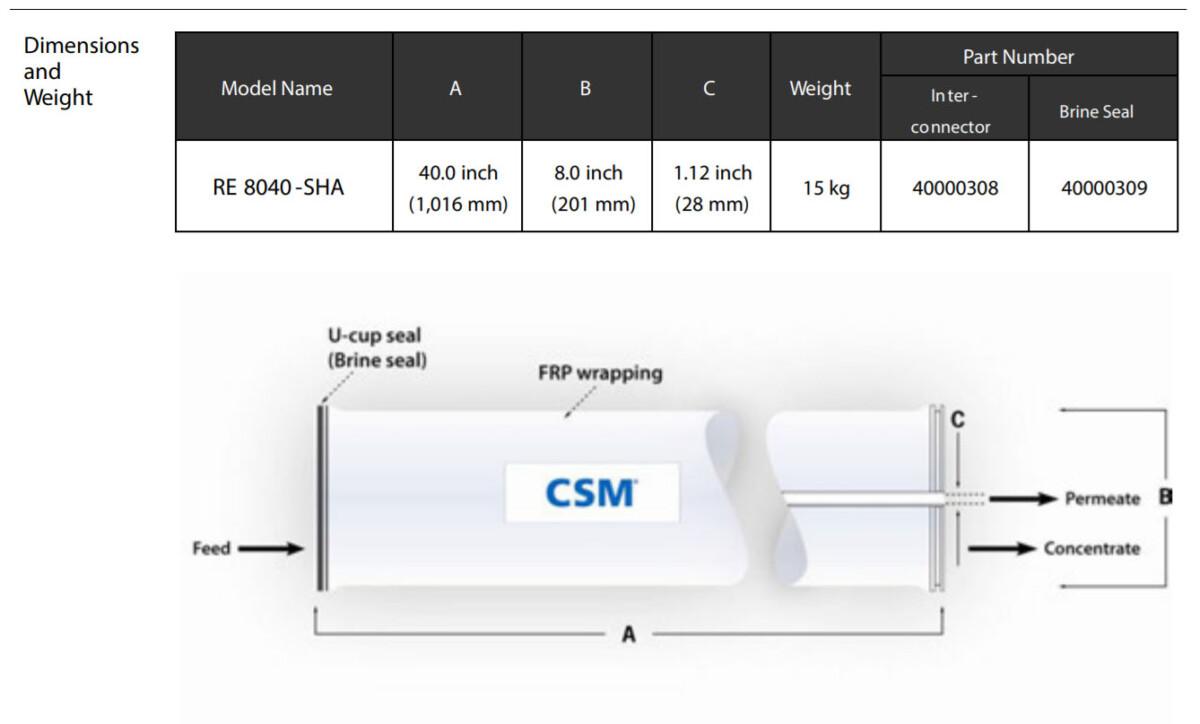
1. The stated product performance is based on data taken after 30 minutes of operation at the following test conditions:
• 32,000 mg/L NaCl solution at 800 psi applied pressure
• 8% recovery
• 77 oF (25 oC)
• pH 6.5 –7.0
2. Boron rejection is 9 2.0% at pH 8.0 and 5 mg/L boron feed with the same test conditions as above.
3. Minimum salt rejection is 99.6%.
4. Permeate flow rate for each element may vary but will be no more than 15%.
5. All elements are vacuum-sealed in a polyethylene bag containing 1.0% SBS (sodium bisulfite) solution and individually packaged in a cardboard box.
| Max. Pressure Drop / Element | 15 psi (0.1 MPa) |
| Max. Pressure Drop / 240” Vessel | 60 psi (0.41 Mpa) |
| Max. Operating Pressure | 1,200 psi (8.27 MPa) |
| Max. Feed Flow Rate | 75 gpm (17.0 m3/hr) |
| Min. Concentrate Flow Rate | 16 gpm (3.6 m3/hr) |
| Max. Operating Temperature | 113 oF (45 oC) |
| Operating pH Range | 2.0–11.0 |
| CIP pH Range | 1.0–13.0 |
| Max. Turbidity | 1.0 NTU |
| Max. SDI (15 min) | 5.0 |
| Max. Chlorine Concentration | < 0.1 mg/L |
1. Elements contained in the boxes must be kept dry at room temperature (7–32°C; 40 –95°F) and should not be stored in direct sunlight. If the polyethylene bag is damaged, a new preservative solution (sodium bisulfite) must be added and air-tight sealed to prevent drying and biological growth.
2. Permeate from the first hour of operation should be discarded to flush out the preservative solution.
3. Elements should be immersed in a preservative solution during storage, shipping and system shutdowns to prevent biological growth and freezing. The standard storage solution contains 1% by weight sodium bisulfite or sodium meta bisulfite (food grade). For short term storage (i.e. one week or less) 1% by weight sodium meta bisulfite solution is adequate for preventing biological growth.
4. Keep elements moist at all times after initial wetting.
5. Avoid excessive pressure and ow spikes.
6. Only use chemicals compatible with the membrane elements and components. The use of such chemicals may void the element’s limited warranty.
7. Permeate pressure must always be equal or less than the feed/concentrate pressure. Damage caused by permeating back pressure voids the element limited warranty.
WhatsApp us