
Every week, someone contacts Innovators Dubai with the same question: “I need fresh water from the sea — but I do not know what to buy.” Sometimes it is a yacht owner preparing for a long ocean passage. Other times it is a project manager at a remote coastal construction site. In other cases, it is a government official facing a freshwater crisis on an island with no groundwater left.
The terminology alone causes serious confusion. Portable seawater RO plant. Water maker. Portable seawater desalination unit. Compact SWRO system. Suppliers use these terms interchangeably online — but they are not always the same thing. Buying the wrong one is an expensive mistake. Innovators Dubai sees this happen far too often.
This guide exists to fix that confusion. We explain what a portable seawater RO plant is and what a water maker is. We cover how they differ, what questions every buyer must ask, and how Innovators Dubai delivers the right solution for your real situation — not a generic one.
Portable Seawater RO Plant vs Water Maker — What is Actually Different?
Let us start with the confusion head on. A water maker and a portable seawater RO plant both use reverse osmosis to turn seawater into fresh drinking water. The science is identical. The membranes are similar. However, the engineering, scale, application, and investment are worlds apart. Mixing them up leads to serious and costly problems.
The term “water maker” was born in the sailing world. Boat manufacturers needed a friendly name for compact desalination units fitted into yacht engine rooms. The name stuck. Today it exclusively describes small, marine-grade reverse osmosis units. These units sit inside a vessel and quietly produce modest amounts of fresh water while a boat is underway or at anchor.
A portable seawater RO plant is a completely different category. It is designed for industrial-grade water production. It serves entire communities, military bases, offshore platforms, or construction camps. It is portable because it moves from location to location — but it is not small, not simple, and not inexpensive.
| Comparison Point | 💧 Water Maker | 🏭 Portable Seawater RO Plant |
|---|---|---|
| Who uses it | Sailors, boat owners, fishermen, charter vessels | Companies, governments, militaries, NGOs, developers |
| Daily output | 100 – 2,000 liters per day | 5 – 5,000+ cubic meters per day |
| Physical size | Fits inside a boat compartment | Skid, trailer, or full ISO container |
| Power draw | 12V DC / 24V DC / 220V AC — very low | High voltage — generator, grid, or solar farm |
| Pre-treatment | Basic cartridge pre-filters | Full multi-media filtration plus chemical dosing |
| Automation level | Simple on/off controls | Full PLC and SCADA with remote monitoring options |
| Setup at new location | Pre-installed aboard vessel — always ready | 4 to 72 hours depending on system size |
| Core technology | Reverse osmosis — polyamide membranes | Reverse osmosis — polyamide membranes |
💡 The simple rule: Fresh water for a boat — buy a water maker. Fresh water for a facility, project, or community — buy a portable seawater RO plant. Buying a water maker for an industrial site is like buying a garden hose to supply a hotel. The technology is related — but the scale is completely wrong.
Who Actually Needs Which System?
Before spending a single dirham, ask yourself: what is my real daily water need? This is the starting point Innovators Dubai uses in every first client consultation. The right answer here prevents every wrong decision that follows.
You Need a Water Maker If…
- You own or operate a sailing yacht, motor yacht, or cruising vessel. You want genuine water independence at sea — no marina fill-ups, no heavy tank calculations, no rationing on long passages.
- You run a charter boat, dive boat, or commercial fishing vessel. The vessel needs safe drinking water for crew and guests during multi-day trips away from port.
- You operate a small island ferry or coastal passenger vessel. Below-deck space is limited and freshwater demand is comfortably below 2,000 liters per day.
- Your priorities are compact size, very low power draw, and quiet operation. You need a system that runs in the background without daily attention from crew.
You Need a Portable Seawater RO Plant If…
- You are managing a coastal construction site, mining project, or infrastructure development. Municipal water does not reach the location and trucking water in is expensive and unreliable.
- You run an offshore oil platform, drilling rig, or marine facility. Workers need reliable volumes of drinking, cooking, and process water every single day — with no exceptions.
- You represent a government body, NGO, or humanitarian organisation. You need to deploy clean water supply rapidly in a disaster-affected or water-scarce coastal area.
- You operate a remote island resort, eco-lodge, or coastal hospitality property. Guest experience cannot depend on unreliable local water infrastructure.
- Your daily freshwater demand exceeds 5 to 10 cubic meters. Any volume above that puts you firmly in portable seawater RO plant territory — not water maker territory.
The Grey Zone — Large Vessels and Small Communities
There is a genuinely tricky middle ground. Large commercial fishing vessels, medium offshore support boats, and small island community water supplies sometimes sit between these two categories. At Innovators Dubai, we handle these grey-zone assessments regularly. We map real daily demand, available space, power source, budget, and operational conditions against the right system specification. Getting this right from the start saves enormous time, money, and frustration.
What Makes a System Truly Portable — Four Real Tests
The word “portable” gets thrown around loosely in this industry. Some suppliers label systems as portable when they actually require days of civil preparation or fixed concrete foundations. Others need complex external utility hook-ups before producing a single drop of water. True portability means something very specific. It matters enormously when choosing a system for emergency, project, or remote deployment.
A genuinely portable seawater RO plant arrives at site fully assembled, factory-tested, and pre-commissioned. The only site connections required are a seawater intake line, a brine discharge line, a power connection, and a product water outlet. From those four connections — the system produces clean water. Nothing else. No concrete. No specialist civil contractors. No weeks of site preparation work before water flows.
Test 1 — Can It Move?
A truly portable system relocates using standard logistics — a truck, a flatbed, a container ship — without special heavy-lift equipment or oversized load permits. If moving the system requires a crane crew and special transport permits, it is not genuinely portable. A week of civil demolition work to move it confirms the same. That is a semi-permanent installation wearing a portable label.
Test 2 — How Fast Does It Produce Water?
Genuine portable systems begin producing water within 24 hours of arriving at a new location. This applies to small and medium units. Emergency deployments cannot wait for extended commissioning timelines. If a supplier quotes more than 48 to 72 hours for commissioning a medium-capacity “portable” system — ask why. Ask what site preparation that timeline assumes.
Test 3 — Is It Fully Self-Contained?
Does the system include everything needed for full water production within its own frame or container? This means pre-treatment, RO membranes, post-treatment, chemical dosing, and controls — all included. Or does it depend on separate external equipment that must be sourced locally? A truly self-contained portable seawater RO plant needs nothing from the local market except power and seawater access. Everything else travels with it.
Test 4 — Can It Relocate Cleanly?
After six months or two years of operation, can the system fully demobilize and redeploy at a new location? It should do so without losing components, requiring major rebuilding, or incurring reinstallation costs close to the original purchase price. If yes — it is genuinely portable. Innovators Dubai designs every portable seawater RO plant to pass all four of these tests under real-world field conditions.
Four Configurations — Which One Fits Your Situation?
Portable seawater RO plants come in four main physical configurations. Each was developed to solve a specific set of deployment challenges. Choosing the wrong configuration for your site conditions is a costly mistake. Good suppliers help clients avoid this upfront.
Skid-Mounted Systems — Maximum Flexibility, Minimum Footprint
All system components mount onto a compact structural steel frame. The unit sits low to the ground and moves by forklift or crane. It fits into tight spaces that trailer or container systems cannot reach. Skid-mounted units suit offshore platforms with limited deck space and vessel engine rooms with overhead clearance restrictions. They also work well on sites where road access limits what can be driven in. Innovators Dubai supplies skid-mounted seawater RO plants from 1 cubic meter per day up to 250 cubic meters per day.
Trailer-Mounted Systems — Road Mobile, Rapidly Relocatable
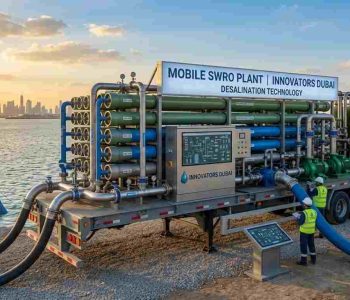
The entire system sits on a purpose-built, road-legal steel trailer with its own axles and tow coupling. A standard flatbed truck moves it anywhere along a coastline in hours. Trailer-mounted units suit emergency response teams, military field operators, and project teams that reposition the system multiple times during a project lifecycle. The trailer itself is the operating platform. The system runs without being lifted off the trailer at all — making relocations extremely fast and simple.
Containerized Systems — Maximum Protection, Global Shipping
All components are pre-installed inside a standard 20-foot or 40-foot ISO shipping container at the factory. The container ships globally by standard ocean freight. It loads onto flatbed trucks without special permits and stacks normally in container yards worldwide. On site, the doors open, four connections are made, and water production begins. The containerized RO plant is the most weather-protected configuration. It is ideal for harsh desert or tropical coastal climates, long-term remote deployments, and clients who may need to relocate operations in the future.
Compact Marine Water Makers — Built for Life Aboard
These units are engineered specifically for vessel installation. They fit into the tightest marine spaces — under berths, inside engine room bulkheads, in dedicated equipment lockers. They run on 12V DC, 24V DC, or 220V AC depending on the vessel’s electrical system. Output ranges from 40 liters per hour for small sailing yachts up to 500 liters per hour for larger commercial vessels. Innovators Dubai supplies marine water makers with full installation and commissioning support across UAE marinas and boatyards.
Real Costs Nobody Tells You About
Every supplier quotes a purchase price. Very few give clients the complete picture of total ownership costs. Here is the honest cost breakdown that Innovators Dubai shares with every client before they commit to anything.
Energy — The Largest Ongoing Expense by Far
Seawater reverse osmosis demands high pressure. High pressure demands energy. Modern portable seawater RO plants with energy recovery devices consume between 3.5 and 5 kilowatt-hours per cubic meter of water produced. Without energy recovery — that number climbs to 8 to 12 kWh per cubic meter. More than double. For a system producing 100 cubic meters per day, this difference can represent hundreds of thousands of dirhams in fuel or electricity costs over five years. Always ask for the specific energy consumption in kWh per cubic meter — not just the pump motor rating — before comparing any two systems.
Membrane Replacement — The Recurring Cost Most Buyers Forget
RO membranes are consumable items with a finite service life. In a well-maintained system operating on properly pre-treated seawater, membranes typically last three to five years. In a poorly maintained system with inadequate pre-treatment, they can fail in under twelve months. Membrane replacement costs are significant — often 15 to 25 percent of the original system price per replacement cycle. Proper pre-treatment and regular chemical cleaning are not optional extras. They are the difference between a five-year membrane life and a one-year one. Savings from cutting pre-treatment costs upfront are always dwarfed by accelerated replacement costs later.
Chemical Consumables — A Monthly Reality
Every portable seawater desalination system consumes chemicals continuously during operation. These include anti-scalant, biocide, acid for membrane cleaning, and sodium hypochlorite for post-treatment disinfection. These costs are predictable and manageable. They must, however, be factored into any honest total cost of ownership calculation. Suppliers who do not mention consumable costs in their proposals are not giving you the full picture.
Service and Maintenance — Non-Negotiable for System Longevity
A portable seawater RO plant running 24 hours a day needs regular professional maintenance. This covers pre-filter cartridge changes, membrane integrity testing, pump seal inspections, dosing system calibration, UV lamp replacements, and control system servicing. Skipping maintenance to cut short-term costs is the fastest way to cause a breakdown. Innovators Dubai offers structured operation and maintenance contracts with 24/7 emergency technical response. Clients get fully predictable operating costs and measurably longer equipment life.
🌊 Innovators Dubai — Portable Seawater Desalination Services
Innovators Dubai has been delivering water treatment solutions across the UAE, GCC, and international markets for over two decades. We do not sell products off a shelf and leave clients to manage the consequences. Every client relationship starts with a proper technical consultation. Genuine after-sales support continues for the full operational life of the system.
Supply of Portable Seawater RO Plants
We supply skid-mounted, trailer-mounted, and containerized seawater RO plants. Capacity ranges from 1 cubic meter per day compact units up to 5,000+ cubic meters per day industrial systems. Every system is specified based on the client’s actual feed water conditions, daily capacity requirements, available power source, site access constraints, and long-term operational plan — never from a generic catalogue specification.
Marine Water Makers
We supply compact 12V, 24V, and 220V marine water makers for yachts, fishing boats, charter vessels, and small commercial craft. Full installation and commissioning support is available across UAE marinas and boatyards. Our team handles everything from system selection through installation, testing, and crew familiarisation.
Installation and Commissioning
Our field engineering teams handle the complete installation process. This includes mechanical and electrical hook-up, system start-up, membrane flushing, performance testing, chemical dosing calibration, and thorough operator training. We do not hand over keys and walk away. Our engineers remain on site until the system is stable, optimised, and consistently producing water to the specified quality and output.
Operation and Maintenance Contracts
We offer structured preventive maintenance programmes at monthly, quarterly, or annual intervals. These cover all mechanical inspections, membrane performance testing, chemical cleaning procedures, pre-filter replacement, dosing system calibration, and 24/7 emergency technical response. Clients operating under Innovators Dubai O&M contracts consistently achieve longer membrane service life and lower unplanned breakdown rates. Total operating costs are significantly lower compared to self-maintained systems.
Rental and Lease Options
For project-based applications or temporary emergency supply situations, we offer fully maintained portable seawater RO plant rental. Both short-term and long-term arrangements are available. The rental unit arrives commissioned and ready to run. Innovators Dubai handles all maintenance, consumable supply, and technical support for the entire rental period.
Spare Parts and After-Sales Support
We maintain a UAE-based inventory of genuine RO membranes, high-pressure pump components, cartridge filter elements, dosing pump parts, UV lamp assemblies, and key chemical consumables. When a critical component needs urgent replacement, our clients do not wait weeks for international freight. We deliver and install — fast. Our marine and offshore clients across the UAE and GCC rely on this local support infrastructure every day.
📞 Speak with our technical team — free consultation, no obligation:
🌐 innovators-dubai.com/contact-us | ✉️ Info@innovators-dubai.com | 📱 +971-544942902 | Dubai, UAE
Six Buying Mistakes That Cost Real Money
Two decades in water treatment across the Middle East means Innovators Dubai has watched the same purchasing errors repeat themselves. Knowing these mistakes in advance is the most valuable thing this article can offer any first-time buyer.
Mistake 1 — Trusting the Headline Capacity Number
Suppliers quote production capacity under ideal conditions — specific salinity, specific feed water temperature, specific operating pressure. Real-world conditions are rarely ideal. Arabian Gulf seawater in summer is significantly warmer and saltier than standard test conditions. Both factors reduce actual membrane output, sometimes by 15 to 20 percent. Always ask: “What is the guaranteed output at my specific feed water temperature and salinity?” That number is the one that actually matters.
Mistake 2 — Choosing a Supplier Without Local Service Presence
Buying from an overseas supplier with no UAE service capability looks cost-effective — until the first serious breakdown. Emergency parts take weeks to arrive internationally. Remote technical support across time zones is slow and frustrating. When a portable seawater RO plant is the only source of fresh water for a site, downtime is not an inconvenience — it is a genuine crisis. Choose a supplier with engineers physically based in the UAE who can be on site within 24 hours.
Mistake 3 — Ignoring Seasonal Feed Water Variation
Seawater quality changes dramatically with the seasons. Turbidity spikes during algal bloom periods in the Arabian Gulf. Salinity levels shift with depth and coastal geography. Temperature swings between January and August affect membrane performance and biological fouling rates. Pre-treatment that handles January feed water perfectly can be completely overwhelmed in July. A properly engineered system is designed around worst-case feed water conditions — not seasonal averages. Make sure your supplier has assessed actual feed water quality at your specific location before specifying the system.
Mistake 4 — Underestimating Total Power Requirement
Many clients size their generator based on the nameplate rating of the high-pressure pump motor alone. However, a complete portable seawater RO plant also draws power for pre-treatment pumps, chemical dosing pumps, UV sterilizers, instrumentation, control systems, and facility lighting. The total connected load is always meaningfully higher than the headline pump rating. Always get a complete power consumption breakdown covering all auxiliary loads before specifying your power source. Otherwise your generator will be undersized from day one.
Mistake 5 — Sizing for Average Demand Instead of Peak
Average daily water demand is a useful planning reference. Systems must, however, handle peak demand — not averages. A construction camp with 200 workers averaging 50 liters per person per day has an average need of 10 cubic meters. During shift changes, hot weather, and weekend activity, actual peak demand can reach 15 to 18 cubic meters in a single day. A system sized for the average runs at 100 percent capacity every peak day. There is zero margin for membrane performance decline or maintenance shutdowns. Always size for peak demand plus a 20 to 25 percent operational buffer.
Mistake 6 — Not Checking Consumable Availability and Cost
Some suppliers offer attractive purchase prices but use proprietary filter cartridges or non-standard components. These are available only through them at premium prices. Before signing, get a written list of all consumables the system requires — filter element sizes, chemical specifications, membrane part numbers. Verify they are available from multiple suppliers at competitive market prices. At Innovators Dubai, we specify only globally standardised components. Clients can source these from multiple channels. We never create artificial supply dependencies.
Questions to Ask Any Supplier Before You Sign
Whether you are considering Innovators Dubai or any other supplier, these questions must be answered clearly in writing before you commit. A supplier who cannot or will not answer them honestly is a supplier worth walking away from.
Technical Questions
- What is the guaranteed daily output at my specific feed water salinity and temperature — not at standard test conditions?
- What is the total system power consumption in kWh per cubic meter — including all auxiliary equipment, not just the main pump?
- Does the system include an energy recovery device? If not, what is the energy cost impact over five years of operation?
- What membrane brand and model number is used, and what is the realistic expected service life under my operating conditions?
- Is the pre-treatment specification appropriate for my actual feed water quality at my specific location — and has that quality been tested or assessed?
Commercial and Support Questions
- Do you have engineers physically based in the UAE who can respond to an on-site breakdown within 24 hours?
- What does your warranty specifically cover, and what does it specifically exclude?
- Are all critical replacement parts available locally in the UAE, or do they come from international suppliers with multi-week lead times?
- Can you provide contact details for two or three clients currently operating a similar system in similar conditions in the UAE or GCC?
- Do you offer rental or lease options if our project scope or timeline changes after purchase?
Frequently Asked Questions
What is a portable seawater RO plant?
A portable seawater RO plant is a fully self-contained, mobile water treatment system. It converts raw ocean water into clean drinking water using reverse osmosis technology. Unlike a fixed desalination plant, it requires no civil construction. It arrives factory-assembled and tested, and begins producing water within hours of arriving at any coastal location.
What is portable seawater desalination?
Portable seawater desalination removes salt, minerals, bacteria, and dissolved contaminants from raw ocean water. The result is safe, potable fresh water — produced using a mobile, relocatable reverse osmosis system. It serves any application where fixed water infrastructure does not exist, cannot be built quickly enough, or is not economically justified for the project duration.
What is a seawater RO plant?
A seawater RO plant is a reverse osmosis water treatment system engineered for the high salinity of ocean water — typically 35,000 to 45,000 milligrams per litre of dissolved salts. It uses high-pressure membranes and pumps to physically separate fresh water from salt water. Seawater RO plants exist in both large fixed municipal configurations and compact portable mobile configurations.
What is a water maker?
A water maker is a compact, marine-grade reverse osmosis desalination unit. It is designed for permanent installation aboard boats, yachts, and small vessels. It produces fresh drinking water from seawater while the vessel is at sea. Water makers typically produce between 100 and 2,000 liters per day. They run on low-voltage DC or standard AC power from the vessel’s electrical system.
Does Innovators Dubai supply portable seawater RO plants in the UAE?
Yes. Innovators Dubai supplies, installs, commissions, and maintains portable seawater RO plants and water makers across the UAE, GCC, and internationally. We offer systems from 1 cubic meter per day compact units to large industrial containerized systems. Rental arrangements are also available. Contact us at innovators-dubai.com/contact-us for a free technical consultation.
Does Innovators Dubai offer rental of portable seawater RO plants?
Yes. Innovators Dubai provides fully maintained portable seawater RO plant rental for short-term and longer-term operational needs. Rental units are delivered, commissioned, and serviced throughout the rental period. Our team handles demobilization as well — clients focus on their operations while we ensure clean water production.
How do I know if I need a water maker or a portable seawater RO plant?
If your freshwater need is for a boat or small vessel producing under 2,000 liters per day — you need a water maker. If your application is industrial, commercial, governmental, or community-scale with daily needs above 5 cubic meters — you need a portable seawater RO plant. For situations in between, Innovators Dubai provides a free technical consultation to identify the right system for your exact operational profile.
The right choice becomes straightforward once you understand what each system was designed to do. The real challenge is finding a supplier who understands your situation, specifies the right system honestly, prices it transparently, and stands behind it with genuine local after-sales support. That is exactly what Innovators Dubai has built its reputation on — for over two decades across the UAE and beyond. Contact our team today and let us help you get fresh water from the sea, reliably, wherever you need it.
📖 Related Article: Looking for a fully mobile, rapidly deployable containerized desalination system? Read our complete guide: Mobile Sea Water RO Plant — Complete Guide to Mobile Seawater Desalination